Mostrando entradas con la etiqueta cuban doctors. Mostrar todas las entradas

domingo, diciembre 04, 2016

Castro's legacy: Cuban doctors still go abroad, but it's no longer driven by international solidarity

It used to be one of Fidel Castro’s flagship methods of spreading international communist solidarity to the rest of the world: sending doctors abroad. But in recent years, it also became a way for the US to tempt doctors to defect.
In early 2016, the Obama administration indicated it might put an end to a programme that offers Cuban doctors on international missions an American visa if they want to defect. Since it was set up by the Bush administration in 2006, 7,117 visa applications have been approved by the US Cuban Medical Parole Programme.
For some Cuban doctors I have spoken to as part of my ongoing research, the possibility of a US visa was the sole incentive for them to apply for a mission abroad. As one doctor I interviewed in Miami said to me, the only reason she solicited a mission in Eritrea was because it offered her an opportunity to escape from Cuba and start a new life in the US.
While the indications that this programme could stop came as part of the rapprochement between Cuba and the US, there is renewed uncertainty about the future of Cuba-US relations with the election of Donald Trump.

Soft medical power

But the history of Cuban doctors spending time on a mission abroad goes back much longer – and did not start with the goal of a new life in America.
The programme started shortly after the US embargo was implemented and Cuba was expelled from the Organisation of American States in 1962. Sending international missions abroad was a way of establishing new international relations, helping Cuba out of this forced isolation. In 1963, the Caribbean island initiated its first long-term international solidarity programme by sending a group of doctors to Algeria for 14 months.
Since then, Cuban health care professionals have offered their services all over the world – from Africa and South America to Portugal. Official numbers published by the Cuban newspaper Granma in 2014 reported that 131,933 Cuban doctors have participated since the early years of the revolution in missions to more than 107 countries. These international solidarity missions offer disaster relief, help when epidemics, such as the ebola outbreak in West Africa, arise, and provide health care provision in remote areas where patients have never had access to a doctor.

Motivations have changed

Through my ongoing oral history research, interviewing Cuban health care professionals both living in Cuba and abroad, I have seen a clear shift in the motivations for why people take part in missions overseas. While 50 years ago they were motivated by humanitarian passion and revolutionary conviction, economic interests and a chance to escape Cuba now drive their desire to work abroad.
Sergio (not his real name), is a retired doctor I interviewed in Cuba in July 2016. He first went on a mission in 1974 to Equatorial Guinea, then again to Haiti in 2002 and to Botswana in 2014. In the 1970s, participating in a mission was an honour as it was a way to help other countries in need, as well as to support the Cuban Revolution. As Sergio explained:
I saw many needs. I identified a lot with the programme of the revolution. Why was the Cuban internationalism necessary? Everything we did, we did it with love, with affection. The little we had, we gave it.
Although there were some economic incentives, such as the opportunity to buy a car, the main reason they took part at that time was a revolutionary passion, a humanitarian conviction, and possible career development upon their return. It wasn’t easy – and participation often meant 11 months away from their families with limited contact possibilities. Yet they were proud to provide support to the revolutionary process and health care to those in need. As Sergio said of his first mission:
From a personal point of view, it was very unpleasant, but I came back very happy, with my internationalist card of the mission accomplished.
Although the 1980s were a good economic period for Cuba, the fall of the Soviet Union changed everything. Two of the doctors I interviewed who were on a mission in Africa between 1989 and 1991 said that when they returned to Cuba, they were confronted with a country that wasn’t the one they had left two years earlier.
The economic consequences for Cuba were devastating. During what has been called the “special period in time of peace”, food became scarce, apagones (power cuts) were common, and Cuban people had to come up with ways to survive. This readjustment to the new economic circumstances, known as la lucha (the struggle), changed Cubans’ mindsets.
Many health care professionals opted to apply for missions at that time out of financial necessity. Sergio explained to me that he decided to go to Haiti “because I needed to eat. My salary here wasn’t enough”. Although not high, the salary paid to the internationalists is still much better than the one they receive in Cuba.

Cuban doctors gather in Havana. Alejander Ernesto/EPA

The 21st century has been marked by mass missions in South America. Thousands of Cuban health care professionals were working in Venezuela under the government of Hugo Chavez, and many of them are still sent there on a regular basis to work with the Mais Medicos programme in Brazil.
There is no doubt that participating in these missions has improved the financial situation of those who have taken part and their families. Some have saved to renovate their houses, others to purchase goods they would never have been able to afford in other circumstances. But this money never lasts very long because, as Sergio explains, everything is very expensive in Cuba, despite the country’s economic situation.

Impact on Cuban society

One of the common criticisms of sending Cuban doctors abroad is that it is a form of “selective humanitarianism” that diminishes the number of doctors in Cuba. Many of the people I talked to in Cuba during my research said they had to go to another health clinic, known as a consultorio, because their doctor was working on a mission abroad.
Cuban families have also suffered due to the prolonged separations linked to the missions. There are no official numbers about divorces linked to the international solidarity programme, but many of the participants involved explained to me that many couples separated – some of whom had defected to the US.
Being part of the international solidarity programme has been a very enriching and eye opening experience for many health care professionals, both from a professional and a personal perspective. But it has a complicated legacy and may not have always resulted in the best for the Cubans left behind.
The Conversation
Stéphanie Panichelli-Batalla, Lecturer in Spanish and Latin American Studies, Aston University
This article was originally published on The Conversation. Read the original article.

miércoles, febrero 24, 2016

Medicine capitalist in Cuba.

There are double standards discriminatory and exploitative Cuban doctors and patients both for foreign patients.
By Dr. Eduardo Enrique Herrera Duran.*
For many in the world, in Cuba, medical care is free. But actually it is not so, and especially for tourists. People who visited the island and ill, have seen are required a hefty payment in foreign currency by the health services required.
Some foreigners complained that they have to pay for any services of this type that will deliver to them at a much higher price than in some of their countries, and with less quality. In addition, sometimes they are examined by several specialists unnecessarily, charged each query in order to increase the final amount.
As medical specialists, sometimes forwards us cases to assess as surgeons who had simply not are sent to our service. In my opinion, this happened for the effort to add an unnecessary specialist consultation and thus charged more.
An example of this occurred on February 14 of Calixto Garcia University Hospital at emergency room. A German patient who suffered several diarrhea ended envoy to be valued by the emergency surgery and therapy, most without this case required it, which was discussed by the medical team.
Hospitals such as the Cira García, Camilo Cienfuegos and the CIREN (Neurological Restoration Center), are those who receive largest number of foreigners. Others only have some rooms which cater to this type of patient, as it is the case of the Hospitals Pando Ferrer, Hnos Amejeiras and CITED (Ibero-American Centre for the Elderly), in the Calixto Garcia University Hospital.
Ambulances available in the Hospital “Cira Garcia". Author’s photo
Hospitals and rooms primarily responsible for the care of foreigners have better comfort. The equipment is superior and the staff working in them are familiar with provide a service that is not customary in health centers where are served our neighbors.
When tourists arrive to seek medical attention, are required to pay either cash or insurance cards. However, despite such outlay, the doctors who are in charge of care for them not benefiting from this gain. They receive the same salary as all other specialists (approximately the equivalent in pesos to about 60 to 70 dollars a month).
Thus, is the most profitable business for the Cuban State, forming a large number of professionals in the sector without investing much in it. The teachers who teach them usually win approximately 80 dollars a month.
Formed as low-cost physicians are sent to many countries for the so-called "medical collaborations". As a result, and unlike the worker who produces them, the Cuban State receives juicy profits.
This machine make money also joined the physicians from other countries who are studying on the island. Input, and only by registration for the specialty, pay 18 thousand dollars annually. This figure would represent a fortune to any Cuban, even being a teacher of the most qualified. Working in Cuba, could not meet this amount in a lifetime.
Cuba is a paradox for scholars of classical Marxism. For those who still believe in the myth of free medicine, "Socialist" model was transformed into a country where the capitalist health care method, applies more however wages which sustain it remain insufficiently low.
* Dr. Eduardo Herrera Duran is a physician specialist in Surgery. He lives in the city of Havana, Cuba and works at the University Hospital "Calixto García". He collaborates with the independent Cuban Press Agency, Hablemos Press, on health issues. Some of his articles appear in the Blog of Cuban Medicine.  (Microsoft translator)

lunes, enero 18, 2016

Cuban surgeons rented to Chile.

The Cuban regimen sells qualified health workforce and denied the right to do the same on their own.
By Dr. Eduardo Herrera. *
In the emergency at Department of surgery at the University Hospital "Calixto García", last December 18, informed medical specialists the chance to go to work in Chile for 3 months. The salary offer is thousand dollars a month, according to rinse off the head of the service, informed by the director of the Hospital.
This happens only a few weeks have restricted travel of physicians by announcement. According to the official note, it was a measure that was taken by necessity, since they caused a deficit in attention to the population. However, the official argument does not seem very relevant, especially if they are still devoting thousands of doctors to work in other countries, sent by the same nurture which prohibits such a decision when it is private.
With this measure, the national Government leaves clear how slavery way medical staff has. It offers Governments taking a figure much higher than that paid to the same doctors, even less to those who see a natural counterpart of the country that sent them.
So both Governments with the benefit that produce well-qualified professionals are preferred.
University Hospital "Calixto Garcia" La Habana,Cuba
The Cuban Government gets scandalous profits and the recipient Government indirect advantages in economic, or direct political. In the first case, due to the low wage that perceived labor for rent, pocketing nurture 75% of what you earn. And in the second case, because the cheap coming out to the recipient country improvements in the health service which would offer its citizens.
Different rulers are using this business with huge gains of the Cuban State to succeed in his political campaigns. And they do so without repairing what is subjected to these Cuban professionals in their own country of origin, receiving wages that do not pass 70 dollars a month. It is a figure that would not reach them to lead a life as any industry professional in another nation, even poorer.
Therefore, what the Cuban authorities are trying to prevent is the output of many physicians with personal contracts, by those who perceive much more fair wages. And probably achieve their objectives thanks to coercion imposed to its analogues.
Case, it is the reason that is, is abruptly reduced supply of free private contracting of Cuban specialists had been proposing in countries such as Angola, Ecuador, Trinidad and Tobago, Chile and some more.
Prices for the legalization of titles and notes by the Cuban Ministry of Foreign Affairs (MINREX), as well as the passport and the passages are very high in relation to the salaries that are paid in our country. However, many still try to sell what little they possess in the family to make going out to work to another nation, in search of a decent remuneration.
A lot of doctors in Cuba are ready to be hired in countries where the human work we do is recognized and therefore will pay us fees that really meet our needs. The democratic countries  where reigns the justice independent of the State, should not make deals with modern slavers as the Cuban State. And medical schools or other organizations as the World Labor Organization (ILO online) should prevent to continue with the exploitation of their doctors.
*Dr. Eduardo Herrera Duran is a physician specialist in Surgery. He lives in the city of Havana, Cuba and works at the University Hospital "Calixto García". He collaborates with the Cuban Agency of independent press, Hablemos Press, on health issues. Some of his articles appear in the Blog of Cuban Medicine. (Microsoft translator)

viernes, septiembre 18, 2015

Cuban officials and doctors misinform about causes of death and transmissions diseases.

Officials and Cuban doctors use abstract language to misinform.
By Oscar Sánchez Madan.*
Officials of the sector's health in Cuba use an indefinite language referring to the causes of the deaths of patients in hospitals and epidemics spreading in several regions of the country. The purpose is to misinform the public.
For cholera employ the expression "disease of digestive transmission" and when referring to a town where there are cases with dengue, allege that "it has waged a campaign against outbreaks of the mosquito Aedes Aegypti", or that "there are people on suspicion" of contracting the ailment.
Another of the euphemisms used is "influenza vaccination campaign", of the efforts to combat the Influenza A virus. This causes highly infectious and dangerous diseases such as bird flu, and the swine flu.
Misinformation or inaccurate communication on diseases and epidemics that affect citizens Matanzas, contributes to these manifest apathy when you call support medical campaigns, is trust, and do not protect against phenomena that they represent common and not risky.
Cuban doctors with Health Minister, Roberto Ojeda, 
arriving at a hospital.
A year ago died in hospital Faustino Pérez, of the city of Matanzas, Mr. Marcelo Marcial Rivero Alonso, who resided in Cidra, community of the municipality of Union de Reyes. Days before his death, he suffered severe diarrhea, vomiting, fever, thirst, strong cramps in the stomach and decay. These are the symptoms of cholera. However, was diagnosed as a cause of death "septic shock".
"Respiratory Distress (suffering)" was the diagnosis of the doctors at the military Hospital for the death, on 6 September last, Pedro Francisco Rodríguez Díaz, 57-year-old national, who also resided in the town of Cidra. This had entered on day 3, with the symptoms of the influenza A H1N1: increased nasal discharge, high fever, cough, sore throat, vomiting and decay.
It has become common to that to outbreaks of Dengue and Influenza A H1N1 as will affect dozens of citizens in Matanzas territory. An official of the Provincial Center of hygiene and epidemiology   speaks of "suspected cases", not sick, referring to mourners. In this way they try to preserve the false image created on the Cuban health system.
It's no secret to the bureaucrats in the health sector the elementary right of citizens to receive detailed, accurate and timely information.
In the province of Matanzas, a few days ago referred to the municipalities "major problems" in the fight against outbreaks of the mosquito that transmits Dengue (Cardenas, Matanzas, Colon and Jagüey Grande). It is disturbing that they have not mentioned the rest of the affected municipalities.
But cited ambivalent language is not exclusive of officials of State medical institutions. In the national housing body are called "extractions" unfair evictions of people from their homes, planned and led by the ruling party.
The executives in the sector of health and medical staff must report accurately all that put in danger the life of citizens; they have an obligation to abandon his abstract language, because it misinforms and, far from resolving problems, complicates them. It is time for the people to respect and speak frankly.

*José Óscar Sánchez Madan, is a Cuban journalist and author in several Cuban newspapers, and a regular contributor of the Miami-based independent news agency CUBANET.

viernes, agosto 21, 2015

Abandonment and neglect in the health system in Cuba.

Health in Cuba: apart from the impressive achievements.
By Paulino Alfonso Estevez.
It is true that in comparison with African countries and many in Latin America and Asia, in terms of health, Cuba can show impressive achievements, which are presented by the propaganda of the regime as one of the greatest achievements of the revolution.
However, in public health in Cuba, beyond the impressive achievements, there are enough abandonment and neglect. Suffice it to recall that in January 2010, in the Psychiatric Hospital of Mazorra, died of hunger and cold in 26 patients.
The Castro regime, in Exchange for money and political purposes, diverted to other countries health care, to the detriment of the Cuban people.
Patients who died on the Psychiatric Hospital of malnutrition and cold.
Since 2002, only for medical services, the Cuban regime has received 120 000 000 $ of the Venezuelan Government.
It also receives annually 2 500 000 dollars on the part of other more than 30 Governments also staffed by Cuban doctors.
No country in the third world has received such amount of money for the export of human resources.
Despite this avalanche of money giving the exportation of medical and paramedical, the Cuban people live, as saying the Spanish, to two servings, of hunger and need.
A few years ago, as reported to the Communist Party by the then Minister of health, José Ramón Balaguer, in Havana there was 300 closed clinics because "their doctors were in Venezuela or other countries".In the other provinces had nearly 500 clinics closed.
For 20 years the regime not dealt with repair of clinics, polyclinics and hospitals. 5 years ago decided to undertake partial repairs (have only made an overhaul in the Hospital "Calixto García", in El Vedado).
Six years ago, a Prince of Saudi Arabia donated 30 million dollars for the reconstruction of the children's Hospital "Pedro Borras", Vedado. But it seems that this donation was used in another thing, because what was that children's hospital is now a heap of ruins. ( Microsoft translator)
Read in Spanish: AQUI

martes, mayo 26, 2015

¿Why hoarding in Cuban Public Health System?

By Dr. Eduardo Herrera.*
Most state workers in Cuba have the need, in a personal capacity, getting the tools, material and to determine the places where they work. Public health has not escaped this phenomenon.
Doctors, nurses and many health technicians have to grab some materials to work comfortably and try to avoid complications in patients they serve. Grabbing instruments and medicines needed in their daily work.
Dr Eduardo Herrera. 
"Ensuring sutures, catheters, instruments or any other team gives us work with less stress," pose a group of my surgical colleagues. This would have serious consequences that surprised performing these practices, as they could be expelled from the centers and go to prison.
Notwithstanding the measures taken by the government and not allowed to have materials and instruments in personal lockers for workers, these manage to violate the laws.
Many feel they must ensure their work with patients while some take advantage of gaps to get some gains to alleviate the low wages earned. To at least buy food, clothes and shoes.
The situation is not as simple as it seems, as were the staff, especially doctors myself included. We face problems with patients about the limited possibilities to solve your health problem due to lack of resources. Which we would have to pay in case of a complaint, in a fatal outcome.
The leader in the country, do not present the situation and the shortcomings we suffer, when to punish. The conditions not only work but also of life. They are not taken into account when requiring.
Today we see a surgeon, after taking a crowded bus and traveling for some hours, have to operate a case without taking into account as then finds the stress suffered during the trip. He is considering whether breakfast, because their salary reaches him badly to eat.
The health personnel in Cuba are exposed to these and other difficulties to overcome them are just a way out of mission or collaboration. Reason why the Cuban doctors are always ready to participate in any contingency.
Only then would better working conditions for a while. Earn a little more, have a chance to buy a car or a house, otherwise the government granting it.
As to enjoy their work in other countries, although they supposedly poorest, will provide more opportunities at work and in their lives. 

*Doctor Herrera  is a specialist in General Surgery and works at the University Hospital "Calixto Garcia" in Havana , Cuba where he also resides. Collaborates with the website of Cuban issues ,Hablemos Press.

jueves, marzo 29, 2012

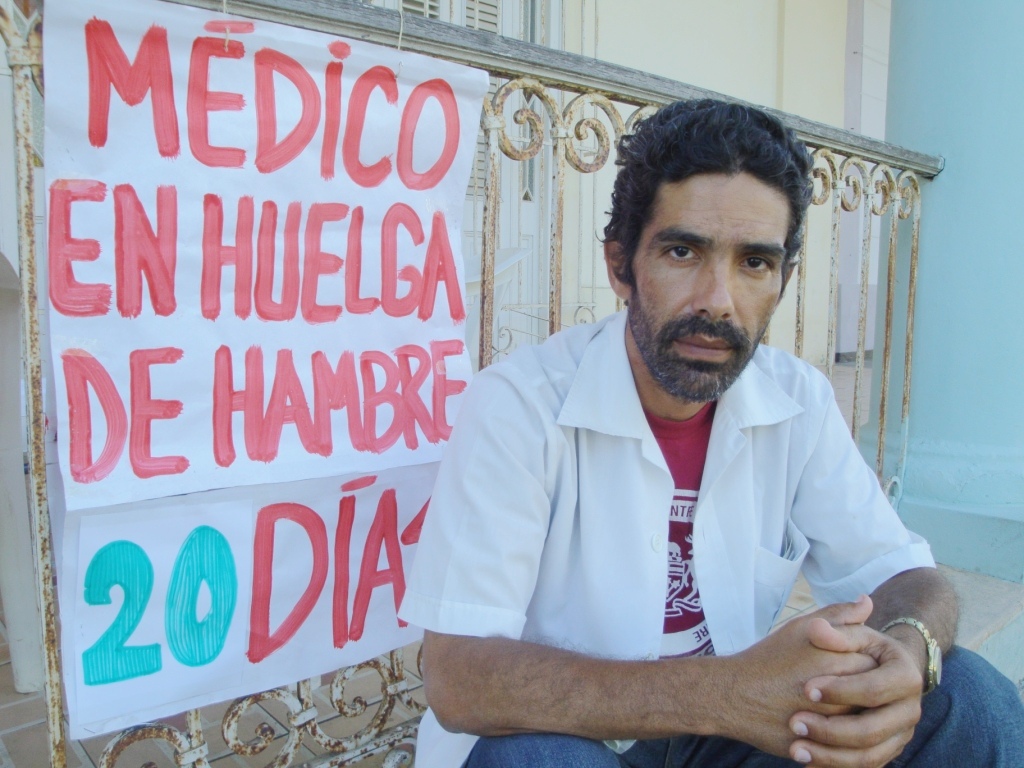
Cuban Doctor in hunger strike’ Day 21.

Dr. Jeovany J. Vega
Today it has been three weeks since the beginning of my hunger strike. The distinctive sign these days has been the absolute silence maintained by the Cuban government authorities and by the officials of the Ministry of Public Health (MINSAP). Absolutely no one, of any government institution or of MINSAP, has made any public pronouncement nor have they approached me to date, or concerned themselves about my case, nor about the hunger strike, nor even, humanely, asked about the state of my health.
None of this surprises me at all; in fact I did not expect some other conduct from institutions and officials who ignored us for five years because, in fact, it was precisely that silence and institutional indolence which brought me here. More than 70 documents submitted in person at the headquarters of the central agencies of government policies and, left without answers one after another for five years, prove it. All this explains why I finally opted for the hunger strike as a last resort to vindicate our usurped rights.
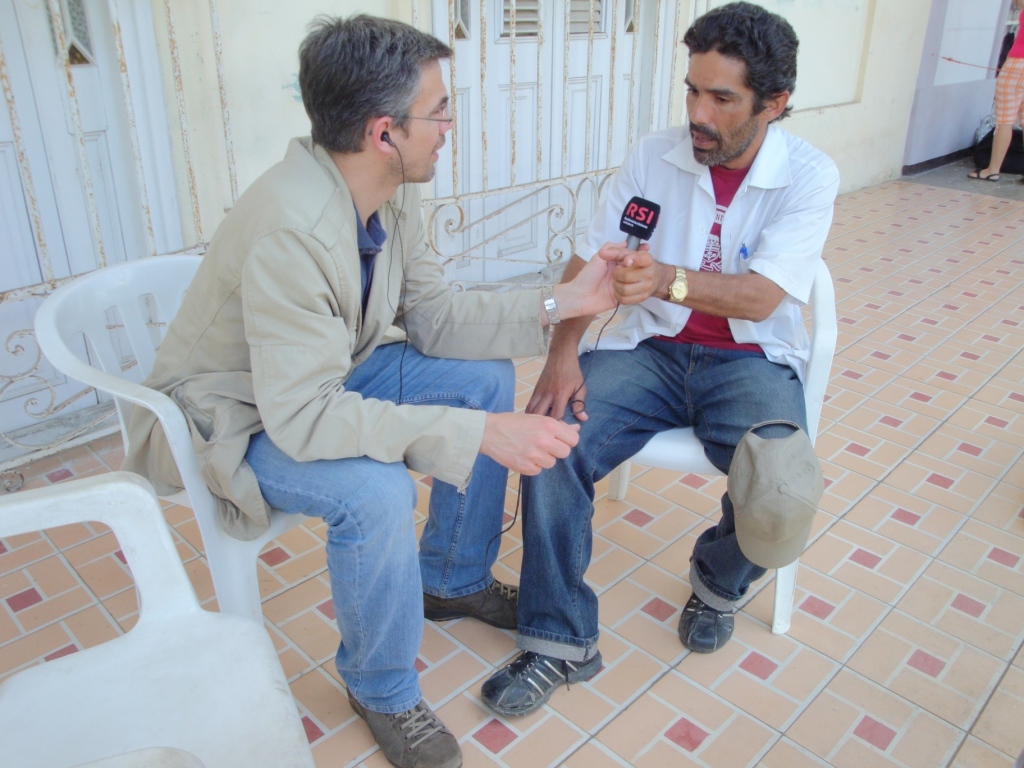
Every day, all week, I have received calls from radio stations in several countries who continue to be interested in the course of the strike and who spread the truth about this case. On the evening of Saturday 24 received a visit from Emiliano Bos, Italian journalist accredited to Havana on the occasion of the visit of Pope Benedict XVI, to whom I gave an interview for the Swiss station RSI, which is heard in much of Europe. (Photo)
On Friday, March 23, at 5:00 pm, I was left empty-handed by ARTV News, the Educational Channel; waiting in vain for the transmission of the interview I granted to the provincial channel on Monday March 19 which they assured me would be transmitted. This is evidence that censorship always prevails, they do not have the courage to publish a truth like this and it was all a trick to be used at their own time of decontextualizing everything, they don’t know how to do anything else.
Although my health is stable, and I try to sleep well and stay hydrated by drinking water frequently and rehydration salts, I am beginning to feel more and more the rigor of fasting and the fatigue accumulated after three weeks. I am already feeling a growing, significant and continuous decline and have already lost, until now, about 24 pounds (I started on March 5th at 154 pounds).
I announced yesterday by Tweeter and affirm here that, given the silence maintained by the Minister, on Tuesday March 27 at 9:30 am I will present myself at the headquarters of the Ministry of Public Health to personally solicit a response. I also affirm my intention to attend, along with Catholic parishioners from Guanajay, the Mass that Pope Benedict XVI will officiate at in Revolution Square on Wednesday 28 March.
Every day that the Cuban authorities and the Ministry of Health decided to continue this fictive silence, it will only sink them more and more in the mud. When they summon up the courage to break the silence only two alternatives will be presented to them: either recognize with humility that everything was a mistake from the beginning and proceed to allow us to practice our profession and reinstate me in my Internal Medicine Residency — something I recognize is remote but it would be possible even for them, the only successful and intelligent outcome –or decide to persist in that untenable lie planted since 2006.
In the second case, it would be prudent for them to count on one more death on their record and to prepare with great care the speech to explain to the world how this young communist militant from 2006, who did nothing other than study medicine and exercise it with love, with no criminal record — nor even prior administrative sanctions — who then wanted to take on one of the most difficult specialties, so comprehensive, which he was not allowed to, ended up as this execrable being they have drawn in their desperate attempt to justify a crime. Although the human suffering they generate doesn’t matter to them, because after all… what’s one more stripe on the skin of a tiger?
(*) Additional information via my cell phone +5358200251 begin_of_the_skype_highlighting            +5358200251      end_of_the_skype_highlighting, land line 362086 (Artemisa) or through Alfredo Felipe Valdés, spokesperson in the case, exiled in Málaga, España, (Cell phone: 627222638). I will keep reporting through Twitter (DrJVega).
Source: Ciudadano cero

martes, octubre 13, 2009

The Truth about Cuba’s infant mortality rates.


A Cuban doctor explains the truth behind Cuba's infant mortality rates.
A Cuban obstetrician, who arrived recently from the island, was interviewed this week by Maria Elvira Salazar on her program "Maria Elvira Live," broadcast nightly on Mega TeVe in Miami.
In a dramatic testimony, the doctor told Maria Elvira about PAMI (Medical Attention Program for Infants), a program designed by the Castro regime to make sure that Cuba's infant mortality rates are kept low, because it represents a propaganda tool for the government.
When an ultrasound done during the pregnancy reveals that something could be wrong with the fetus, the woman is forced to have an abortion.
According to the doctor, further examination of the fetuses after these forced abortions, revealed that the problem was not as serious as it was diagnosed through the use of the ultrasound, and in some cases there was actually nothing wrong and the baby could have been born without complications and live a healthy life.
However, a forced abortion when a possible problem is diagnosed during the pregnancy eliminates the possibility of any of those babies dying after birth and impacting the infant mortality rate, which seems to be the only concern of the Cuban regime.
The doctor also made reference to the lack of treatment that is given to babies who are born prematurely.
He told of one time when he was on duty and a woman gave birth after only 26 weeks of pregnancy.
The doctor sent the baby to a neonatology ward at the hospital, but he died a few hours later.
The next day, he was called to a meeting with the hospital director, where he was told that he should have known by now that babies who are born so premature should not be sent to receive further care because, if they died, it would impact the mortality rate.
He said many premature babies are left to die without receiving any medical care and are later reported as stillborn, which doesn't impact the mortality rate.
He said he knew of cases of premature babies who were born alive and were put in a bag and placed in a closet to be sent later to the morgue as if they were born dead.
Since the Cuban government keeps a very close track of the performance of each doctor at Cuba's maternity hospitals, any doctor who has to report a death of a baby that would impact the infant mortality rate could get in trouble.
That is why many of them prefer to report a stillborn, than take the chance with what the system refers to as "non viable" babies.
Unfortunately, Michael Moore and all the other ignorant people who are always quoting Cuba's infant mortality rates as an example for the U.S. and other countries to follow, will continue to ignore the truth behind those rates.
Source: The Real Cuba


miércoles, febrero 18, 2009

Cuban doctors defect in Venezuela after Chávez's victory.

Large number of Cuban doctors defects in Venezuela after Chávez's victory
I spoke tonight with Dr. Julio Cesar Alfonso; President of Solidaridad sin Fronteras (Solidarity without Frontiers), an organization that helps Cuban doctors who have been sent by the Cuban regime to work in foreign countries and who have expressed a desire to defect.
Dr. Alfonso told me that since Sunday, when Hugo Chávez won the referendum in Venezuela, a "large contingent" of Cuban doctors has defected.
Many have been able to cross the border into Colombia and many others are in hiding.
Some who have been able to communicate with Dr. Alfonso told him that they decided to defect after Chávez victory on Sunday, because they are afraid that Venezuela will soon become another Cuba.
Dr. Alfonso said that it is hard to tell the exact number of doctors who have defected.
People in Venezuela who work with Solidaridad sin Fronteras offering refuge to Cuban doctors who want to defect, have told Dr. Alfonso that they are overwhelmed by the number of Cuban doctors who are contacting them, after they abandoned their jobs in the last two days and went into hiding.
One of the biggest problems for Cuban doctors who try to defect is that as soon as they arrive in Venezuela, or any other country where they are sent, they have to turn their passports to Cuban diplomats in that country.
This makes it very difficult for them to have the proper documents of identification that are required by authorities in other countries where they are trying to go.
In August of 2006, the United States announced a program that would make it easier for defecting Cuban doctors to reach the United States, but the program has never worked as well as it was expected.
Dozens of doctors, who reached Colombia after abandoning their jobs in Venezuela, are still waiting for more than a year for US authorities to respond to their request to travel to the United States.
Source: The Real Cuba. February 18, 2009

viernes, enero 06, 2006

Diabetic says ironically will have to go to Venezuela for treatment.


By: Ana M. Perdigón. *
Erick Pérez Lara, who suffers from chronic diabetes, says ironically that he'll have to go to Venezuela to get his needed treatment.
Pérez Lara said he needs an insulin injection every four hours and that the local hospital is supposed to provide him with all the material so he can treat himself at home: the drug, syringe, alcohol and cotton. He said the hospital now has only the cotton.
"He no longer wants to leave the house because he fears what might happen to him on the street," said his brother, Elvis. "It looks like he'll have to go to Venezuela for treatment."
Lara's remark was a reference to the thousands of Cuban doctors who have been sent to Venezuela under a Cuban-Venezuelan agreement.
* Sancti Spiritus Cuba. Cubanacán Press. 22/12/05